

Five fabrics. One cool night.
We compared the published science on the five most common bedding fibres — polyester, cotton, linen, silk and lyocell. Four of them are quietly working against your sleep.
The 3 a.m. problem
Your body cannot fall — or stay — asleep while it is warm. To reach deep sleep, core temperature has to drop by about one degree, and it has to stay down until morning.S1 Anything that traps heat or moisture around you interrupts that descent — which is why the worst wake-ups cluster in the small hours, when the bed's microclimate has had time to fill with everything you've released into it.
Sleep researchers describe an ideal “bed climate”: air around the skin at roughly 32–34 °C, and — the part almost nobody talks about — humidity kept low.S2 A sleeping adult can release up to half a litre of moisture into the bedding over a single night.S3 Where that moisture goes is decided by one thing only: the fibre your bedding is made of.
We didn't rent a lab coat. Every score on this page comes from published fibre science — standard moisture-regain tables, thermal-comfort studies and sleep-microclimate research. Each claim carries its source; the full registry is at the end of the page.
The contenders
Polyester
Synthetic · PETThe microfibre default of budget bedding. Strong, cheap — and almost completely unable to hold water vapour.
Cotton
Natural · seed fibreThe familiar standard. Absorbs well — then holds what it absorbs against your skin.
Linen
Natural · bast fibreThe old-world cooler. Stiff, breezy, cold to the touch — the fibre lyocell has to beat.
Silk
Natural · protein fibreElegant and gentle on skin — but delicate, and warmer under a duvet than its reputation suggests.
Lyocell
Botanic · regenerated celluloseSpun from eucalyptus pulp in a closed loop. Smooth nanofibril surface, built for moisture transport.
Three tests, no mercy
Moisture handling
Test 01 / 03Moisture regain — how much water vapour a fibre can hold, as a percentage of its own weight, without feeling wet. Higher means the night's humidity disappears into the fibre instead of sitting on your skin.S4S5
Cool touch
Test 02 / 03Thermal absorptivity — how quickly a fabric pulls heat from skin on contact, the physics behind “this side of the pillow feels cold.” Dense, smooth fibres conduct that first touch of heat away fastest.S6S7
Staying dry
Test 03 / 03Where the moisture goes. Lyocell's nanofibrils pull water vapour into the fibre core, so the surface against your skin stays dry.S8 Cotton stores water in the open lumen of the fibre — and hangs on to it. Polyester stores almost nothing: the moisture stays in the air around you.S9
One night. Five duvets.
Drag through the night and watch the microclimate under the duvet — the humidity your skin actually feels — build differently under each fibre.
Illustrative model built from the moisture properties in Tests 01–03S4S8 — a visualisation of the cited fibre science, not a laboratory trace.
The verdict
Scores are our synthesis of the cited literature — argue with us, the sources are at the end of the page.
Built from the winning fibre
YUKI bedding is woven from lyocell spun out of eucalyptus pulp in a closed-loop process — the same fibre that topped two of three tests above. Smooth enough for skin, structured enough to move a night's moisture away from it.
No coatings, no cooling gimmicks, no plastic microfibre. Just the fibre the literature keeps pointing at.
Premium Lyocell Set
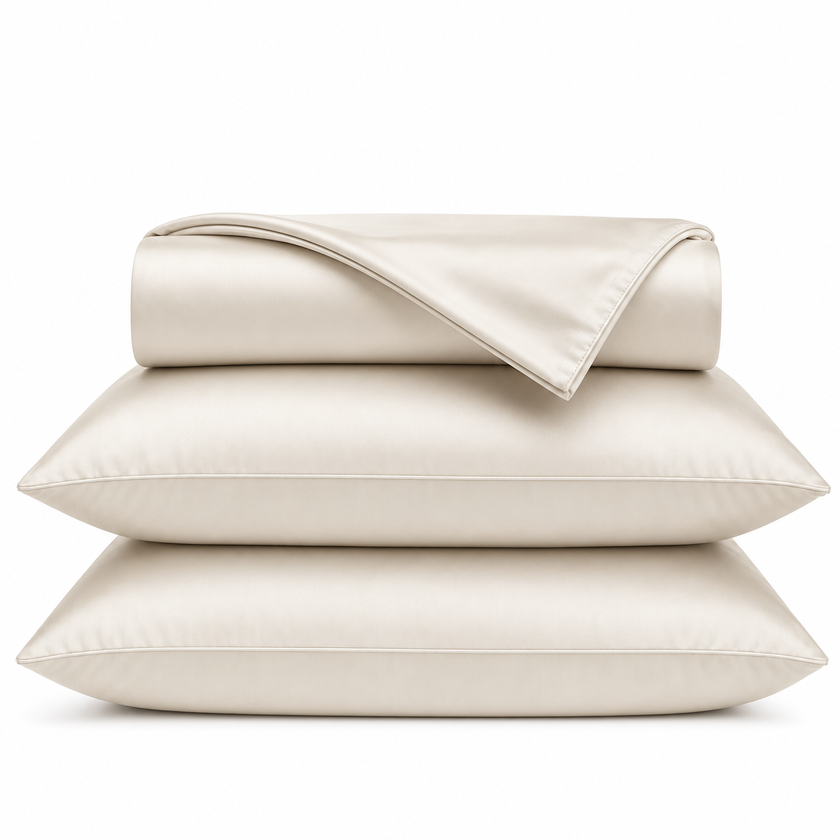
Summer Sale · limited time
Shop the Summer Sale →Honest answers
Is lyocell the same as TENCEL™?
TENCEL™ is Lenzing's brand name for its lyocell fibre — the same fibre class. Lyocell is the generic name, the way “sparkling wine” relates to Champagne.
Will it feel cold in winter?
No — the same moisture transport that keeps the microclimate dry in summer keeps it from feeling clammy-cold in winter. Studies associate a dry bed microclimate with comfort in both directions.S2
Why not just buy linen?
Fair question — linen genuinely won our cool-touch test. It's crisper and heavier in hand; lyocell is smoother, drapes closer, and won the two moisture tests. If you sleep hot and sweaty, moisture wins the night.
Did you actually test these in a lab?
No, and we won't pretend otherwise. Every number here comes from published, cited fibre science — moisture-regain standards, thermal-comfort studies, sleep-microclimate research. The registry is right below.
Sources
- S1Harding EC, Franks NP, Wisden W. “The Temperature Dependence of Sleep.” Frontiers in Neuroscience, 2019.
- S2Okamoto-Mizuno K, Mizuno K. “Effects of thermal environment on sleep and circadian rhythm.” Journal of Physiological Anthropology, 2012.
- S3Umbach K-H. Sleep-physiological studies on bed-microclimate, Hohenstein Institute (moisture release during sleep).
- S4Morton WE, Hearle JWS. Physical Properties of Textile Fibres, 4th ed. — standard moisture-regain tables.
- S5ASTM D1909 — Standard Table of Commercial Moisture Regains for Textile Fibers.
- S6Hes L. Thermal absorptivity of fabrics and the “warm–cool feeling” method, Textile Research Journal.
- S7Militký J, et al. Studies on warm–cool feeling of textile fabrics (thermal absorptivity of cellulosic fibres).
- S8Lenzing AG — technical literature on TENCEL™ lyocell nanofibril structure and moisture management.
- S9Fourt L, Hollies NRS. Clothing: Comfort and Function — moisture in cotton lumen vs synthetic fibres.